
Interest in Finnish Craftsmanship Is Growing Fast. Yle Visited Kasperi to See Why

Applications for this year’s School of Leathercraft has now closed, with a record number of applicants.
We received almost three times as many applications as last year, with a great number of very strong candidates. For us, this was an encouraging sign: interest in craftsmanship, materials and hands-on work is very much alive in Finland.
People want to learn a profession where the work, and the quality of that work, can be seen. A craft where skill develops through doing, and where quality is not just a word, but a concrete goal in every stage of the process.
The Finnish Broadcast company visited Kasperi’s leather bag workshop to see what the training is all about
Yle, Finland’s national public broadcasting company, recently visited Kasperi’s workshop to make a story about our leathercraft training programme and why a small leather workshop in Hämeenlinna has decided to train its own makers.
The story raised one of the central questions behind this work: if we want to make high-quality, highest quality standard craft products in Finland, where do we find the people with the skills to make them? And how do we build the culture required for that level of work?
For a small company, training new makers is a major investment, but for us it is also necessary. If there are not enough ready-trained makers available, the knowledge has to be built ourselves. And when that knowledge is built from the ground up, we can also shape the standards, habits and culture that define how the work is done.

The training was created to answer a real need, and the pilot programme was a success!
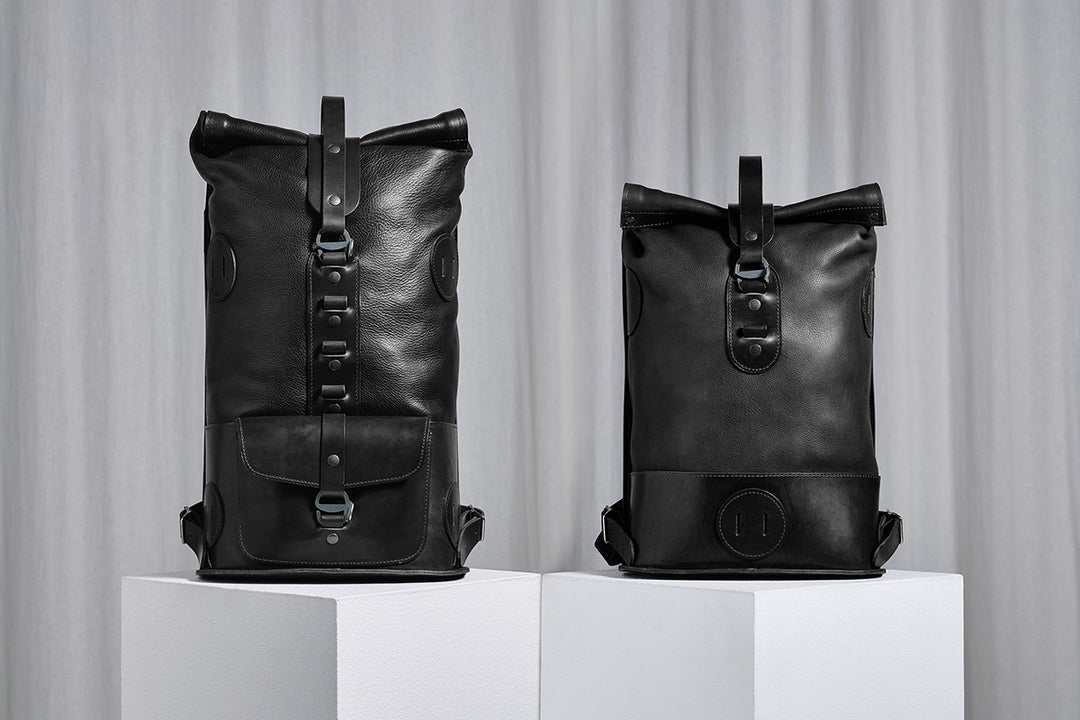
Kasperi makes backpacks and bags in our own workshop in Hämeenlinna, Finland. A large share of our products are sold outside Finland, with our largest customer bases in North America, Europe and Japan.
Keeping production in-house is a central choice for us. When materials, design, manufacturing, quality control, customer encounters and repairs are close to one another, we learn continuously and can keep on creating products that fully live up to their promise.
At the same time, in-house production means that we need skilled makers. Before our own training programme, shoemaking studies were the closest available education in Finland for the skills we need in our work. There are only five shoemaking schools in the Nordic countries, and one of them is in Hämeenlinna. This is the reasons we originally established our workshop here and began collaborating with Tavastia Professional College.
The first School of Leathercraft training programme began last autumn, when three students started a four-month course in which part of the week was spent at Tavastia and part at Kasperi’s workshop at Perttula Manor.
One of the students from the first group joined Kasperi after the programme, while the other two continued their studies within leatherwork. For us, this showed that the model can work: with the right attitude and good guidance, a new maker can find their way into the field.

Towards a craft village of remarkable quality in Hämeenlinna
This year’s number of applicants is the first quiet signal that craftsmanship is not disappearing. Quite the opposite: it is growing, and it has real potential.
Craft can be a profession, the core of a modern business, an export product and a real source of economic growth. Our goal is not only to build one leather workshop, but to help create an entire cluster of high-quality brands and makers in Hämeenlinna.
A concentration where craftsmanship, design, material knowledge, education and entrepreneurship support one another. A place where leatherworkers, textile specialists, woodworkers, metalworkers, shoemakers, repairers, designers and material suppliers could grow side by side.
This is not only about a nostalgic return to the past, but about building the future. Finland, and Europe more broadly, has a strong heritage of craftsmanship, design and material knowledge. Now that heritage needs new structures around it: education, companies, jobs, international customers and places where skills can develop.
This year’s application period is now closed, and next we will carefully review the applications. The first training programme showed that the model can work. This year’s number of applicants showed that the interest and potential are real.
Authentic craftsmanship does not appear by itself. It needs makers, teachers, companies, customers and places where skills can be passed on.
We want to help build such a place in Hämeenlinna.